1.2 International Finance
International finance is any financial engagement carried out across an entity’s borders. International finance thus encompasses acquisition and application of capital funds in meeting financial needs in order to achieve overall objectives of a given entity that operates across host’s borders.
Under the following sections we discuss three theories that explain why international trade happens, globalization and finally we look at international business entities – Multinational Corporations.
1.2.1 Reasons for International Finance
The following theories seek to explain why firms engage in international business.
1.2.1.1 Theory of Comparative Advantage (Developed by David Ricardo)
- The theory states that countries should produce and export goods and services that they can produce efficiently and effectively. This results into specialization that leads to lower cost of production.
- The advantage exists when a country has a margin of superiority (lower opportunity cost) in the production of goods and services.
- The theory of absolute advantage exists where given the same amount of resources, one is able to produce more of a particular product or service than their counterparts. In other words, the ability to produce a similar product/service in large quantities using same amount of resources.
- The key assumption of this theory is that goods and services can move internationally but factors of production are relatively immobile.
Example:
Two countries, Kenya and Uganda can produce the following units of products X and Y per worker. Determine which country comparative advantage in production of each product and the one which an absolute advantage on each product.
| Country | Product X | Product Y |
| Kenya | 10 | 80 |
| Uganda | 20 | 60 |
Solution:
Comparative Advantage:
| Country | Product X | Product Y | Opportunity Cost of Product X (Y/X) | Opportunity Cost of Product Y (X/Y) |
| Kenya | 10 | 80 | 8 | 0.125 |
| Uganda | 20 | 60 | 3 | 0.333 |
Interprentation: Uganda has a comparative advantage over Kernya in production of product X. While Kenya has to forego production of 8 units of product Y to produce 1 unit of product X, Uganda foregoes only 3 units of product Y per unit of product X.
On the other hand, Kenya has a comparative advantage over Uganda in production of product Y because it has lower opportunity cost in production of that product.
For both countries to benefit trade, Uganda should specialise and produce only product X while Kenya produces and exports product Y.
Absolute Advantage:
In absolute advantage, we consider the country that produces highest number of a certain product per worker (labor).
Uganda has an absolute advantage in production of product X. The country produces 20 units per worker compared to Kenya’s 10 units.
Kenya has an absolute advantage in production of product Y. It produces 80 units compared to Uganda’s 60.
1.2.1.2 Theory of Factors Endowment
- The theory of factors endowment as popularized by Heckscher, Ohlin and Samuelson is an extension of the Ricardian comparative advantage model.
- The theory is built on the assumption that countries have abundant factors and scarce factors relative to other countries. The Heckscher-Ohlin model assumes only labor and capital differ between countries. Other factors such as technology varies only between industries but not within industry.
- The theory urges that countries should specialize in and export those products that use to greater extent the factors of production that they are most endowed with and import products which are intensive on the scarce factor.
- All other factors constant, specialization in production of goods and services countries have an advantage in increases output and economic welfare.
- The main difference between the Ricardian model (Comparative advantage) and the Heckscher-ohlin model is that while the former assumes labor is the only factor of production that is variable, the latter assumes countries have relative amounts of each factor of production (specifically labor and capital) which are relatively immobile (variable).
1.2.1.3 Product life-cycle theory
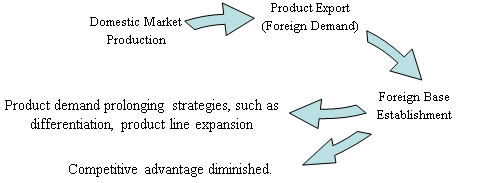
- According to product life-cycle theory, firms become established in the domestic market due to some perceived competitive advantage over existing competitors or availability of information about markets and competition.
- Any foreign demand for the firm’s product will be first satisfied by exporting, then later establishing a base in the foreign market.
- The decision to produce products in the foreign country may be influenced by the need to retain its advantage over counterparts in foreign country by reducing its transportation costs.
- As resident companies copy the product’s advantage, they become less competitive. The company may seek to prolong its products demand by say increasing its product line.
- The theory thus suggests that as a firm matures (moves along the phases of its life cycle) it may realize additional opportunities in foreign country(ies).
International product life cycle
1.2.2 Globalization of the world economy
- Globalization refers to increasingly integrated global economy marked especially by free trade, free flow of capital and use of cheaper foreign labour markets.
- One of the major assumptions of comparative advantage theory and proponents of specialization id the immobility of factors of production across nations.
- The impact of globalization enables transfer of natural resources, labour, capital, knowledge and other production factors fast thus diffusing nation advantage.
- As countries advance, they become more integrated core economies making differences between corporations more important than aggregate differences between countries.
- Thus contrary to the theory of comparative advantage, need for international trade is based on the international mobility of certain factors of production.
- The ability of corporations to use globally available factors of production is a far greater factor in international; competitiveness than the broad macroeconomic differences among countries.
Advantages of Globalization
- Increases Market efficiency – globalization leads to market equilibrium by bridging the information gap in the foreign market. This further leads to efficient methods of producing goods and offering services such as outsourcing, technology, etc.
- Increases Competition – globalization means more options for consumers as a result of increased supply. increased competition leads to lower prices and also improved quality.
- Alleviation of poverty – As wealth becomes mobile, poor countries are able to develop and create opportunities for their citizenry. In addition, globalization reduces level of unemployment.
- Transfer of cultures – globalization has lead to influence of world cultures as countries interact. As a result, good practices have emerged from these interactions.
- Improves security – as countries trade together, they become dependent on each other in some way. This ensures they maintain amicable relations with each other.
- Foreign trade/Investment – globalization has enabled easy transfer of capital from one country to another.
Adverse Effects of Globalization
- Unemployment – with increased competition on a local firms, some are forced out of operations leading to job insecurity and loss.
- Exhaustion of limited factors of production – globalization increasing demand for resources such as minerals that are non-renewable.
- Increase in prices – Sometimes, globalization increases demand for limited resources leading to increased demand, hence higher prices.
- Balance of trade deficits and other imbalances – globalization causes trade imbalances on less endowed countries.
- Cultural vices – globalization has contributed to transfer of poor practices across countries, such as copying of western bad habits by African countries, or vice versa.
1.2.3 The Multinational Corporation
- A multinational corporation is a firm that engages in producing and selling goods or services in more than one country.
- It ordinarily consists of a parent company located in the home country and foreign subsidiaries, with a high degree of strategic interaction among the units.
- The rise of MNC is in contradiction to the doctrine of competitive advantage, which considers trade in undifferentiated product, ignoring the roles of uncertainty, economies of scale, transportation costs and technology in international trade.
- Globalization makes it possible for multinational corporations to operate. Evolution of multinational corporations/enterprises can be attributed to the following factors:
Factors that have led to rise of MNCs
- Search for raw materials – traders in hard – minerals, petroleum products and other raw materials are the earliest multinationals who sort to exploit the raw materials that were found around the world.
- Market seeking – modern MNCs go overseas to produce and sell in foreign market. They include as MNCs such as Coca – Cola, IBM, Procter &Gamble, and Unilever etc.
- Cost minimization – cost minimizers seek out and invest in lower cost production sites overseas (e.g. cheap labour zones) to remain competitive both at home and overseas e.g. Intel, Seagate technology. Off shoring of services can be done either through subsidiary or outsourcing.
- Knowledge seeking – some firms enter foreign markets in order to exploit information and experience that is expected to be useful elsewhere. This is more used by firms that are affected by rapid product innovation and technical breakthrough.
- Keeping domestic customers – suppliers of goods and services to MNCs often will follow their customers abroad in order to guarantee them a continuing product flow e.g. banks, consulting firms, advertising agencies etc.
- Exploiting financial market imperfections – the ability to reduce taxes and circumvent currency controls may lead to greater project cash flows and a lower cost of funds for the MNC than for a purely domestic firm.